The Problem with Paper
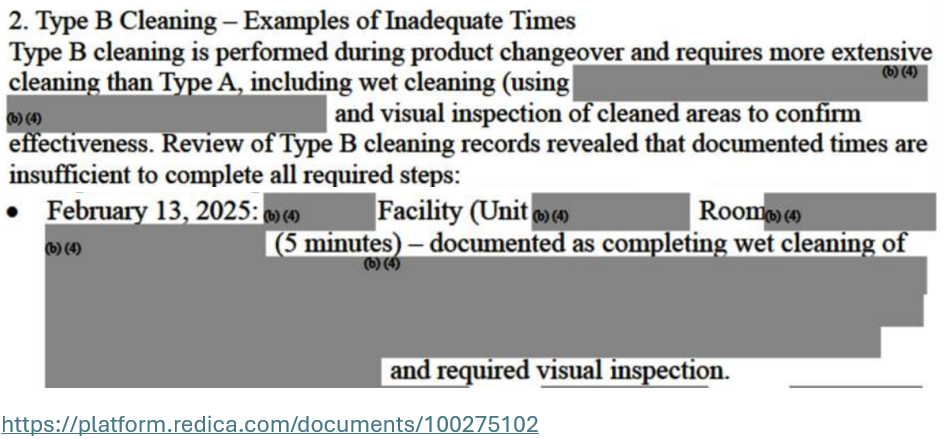
As I was scanning the Redica database this afternoon, I came across an interesting FDA Form 483 related to product changeover cleaning (referred to as “Type B” in the observation) issued on June 30, 2026. It caught my attention because of the data integrity implications and potential impact to product quality (cross-contamination).
The job of the investigator is tough… let’s reflect on the major challenge for a moment before we get into the details: verifying the quality/safety of hundreds of distributed batches (perhaps millions of doses) based on historical record review, many of these in paper format with no underlying secure/time-stamped audit trails. The stress levels of the investigators are high, as there is much riding on the inspection outcome, not the least of which is public health.
In this case, the investigators reviewed historical cleaning records with an eye for accuracy of the data (part of the ALCOA equation), and found what appears to be inability to complete the cleaning in the documented timeframes. As we know from historical data integrity cases, the investigators do not need to prove the data is inaccurate, they simply need to demonstrate that there is “significant risk” that the data is inaccurate (see PIC/s Guide for Classification of Observations). The investigation team notes that in some cases, the changeover cleaning was completed in 5 minutes, which appears to not allow enough time to complete the required tasks.
There are a few potential scenarios here to consider (and probably more):
Not all required tasks were performed
Required tasks were performed, but the times entered for completion are inaccurate
Cleaning was not performed at all
Any one of these scenarios are bad news for the patient, to differing degrees but all significant. As we are likely dealing with paper records, there will be no way to prove the changeover cleaning was inadequate during the inspection - but this does not reduce the significance of the finding. Is the data ALCOA? Could a trained team of personnel complete the cleaning in 5 minutes? Can the records be trusted? The investigation team was unable to answer these questions with confidence, hence the process risk to cross-contamination is high, and combined with the criticality of Type B cleaning, we are likely dealing with a significant overall patient risk. This is an excellent data integrity observation, which could be easily overlooked if the investigation team was simply performing a checklist-style inspection. It seems obvious, but finding and documenting these observations takes specialized training, to find these examples amongst a sea of paper, 99% of which is probably ALCOA.
Did the team stumble across these examples and simply get lucky? Unlikely. The more likely scenario is the team noted some small/minor trigger during the inspection that led them to review these records for accuracy. How did they find the needle amongst the haystack? Critical Thinking and following their training. Excellent.